 listicle
Best Ski Goggles for Flat Light: What Actually Works in 2026?
Last Updated: November 4, 2026
Quick Summary
The best ski goggles for flat light use a yellow or rose lens with a VLT between roughly 40% and 70%, which boosts contrast instead of darkening the snow. Avoid dark gray or mirrored lenses on graybird days, since they mute the luminance differences your depth perception depends on.
- Flat light is a contrast problem, not a brightness problem, so tint and VLT matter more than price.
- A VLT between 40% and 70% suits overcast and flat light conditions.
- Yellow and rose tints absorb blue scattered light to make terrain edges more defined.
- Fixed lenses give a predictable view, while photochromic lenses lag during fast cloud changes.
- Never wipe the inside of the lens, because that is where the anti-fog coating lives.
Table of Contents
- Why Flat Light Ruins Your Depth Perception (and What Fixes It)
- Best VLT for Cloudy Days: The Percentage That Actually Works
- How to Choose Ski Goggle Lens Color for Graybird Days
- Photochromic vs. Fixed Lenses: Which Handles Changing Light Better?
- Anti-Fog Goggle Care: Keeping Your Vision Clear in Wet Snow
- Magnetic Lens Systems and Field of View: What Matters on the Mountain
- Top Picks from ABsnowlife for Flat Light Conditions
- Budget vs. Premium Lens Performance: What Your Money Actually Buys
- Prescription Inserts and Lens Maintenance for Longevity
- Find Your Flat Light Goggles at ABsnowlife
- Frequently Asked Questions
Why Flat Light Ruins Your Depth Perception (and What Fixes It)
Flat light is the optical condition where overcast skies and falling snow strip away shadows, leaving the snow surface as one continuous gray-white blur. The best ski goggles for flat light solve this by boosting contrast, not by darkening the world further.
Here's what most guides get wrong: they treat flat light as a brightness problem. It isn't. It's a contrast problem. When clouds diffuse sunlight, every bump, dip and ice patch loses the shadow that told your brain "this is a drop." Your eyes keep working, but your depth perception quietly stops.
The fix lives in the lens. A tint that filters the right slice of the light spectrum pulls terrain definition back out of the gray. According to the Canadian Ski Patrol's snow safety resources, visibility is one of the most underrated factors in on-hill decision making. At ABsnowlife, we see the same thing every season: riders blame their legs when the real problem is their lens.
Below, we'll show you exactly how to match lens color, VLT and anti-fog design to graybird days, so you stop guessing and start seeing the snow again.
Best VLT for Cloudy Days: The Percentage That Actually Works
The best VLT for cloudy days sits between roughly 40% and 70%. Visible light transmission, or VLT, is the percentage of available light that passes through a lens to your eye. Higher numbers mean more light reaches you.
For overcast and snowfall, that range keeps the snow bright enough to read texture without washing it out. Drop below about 20% and you're wearing sunglasses in a dim room. Push past 80% and glare off the snow starts flattening the very contrast you wanted.
A quick reference:
| Condition | Suggested VLT | Why |
|---|---|---|
| Bright sun, bluebird | 5-20% | Cuts glare, protects eyes |
| Mixed clouds and sun | 20-40% | Balanced all-round lens |
| Overcast, flat light | 40-70% | Maximizes contrast and depth |
| Heavy snowfall, whiteout | 60-80%+ | Squeezes light out of gray |
What most guides miss is that VLT is a starting point, not a verdict. A 60% lens with the wrong tint can still leave you squinting at a featureless slope.
How to Choose Ski Goggle Lens Color for Graybird Days
Choosing ski goggle lens color comes down to one job: pull contrast out of gray. But the reason certain tints work is rooted in how your eyes and brain process color under low-contrast light, and understanding that mechanism makes the choice far less arbitrary.
Under overcast skies, the light reaching the snow is spectrally broad but low in intensity, and the snow surface reflects most of it evenly. Shadows disappear because there is no strong directional light to cast them. Your visual system relies on luminance differences, edges where one patch of snow is slightly darker or brighter than the next, to build depth. When those differences shrink, so does your depth perception.
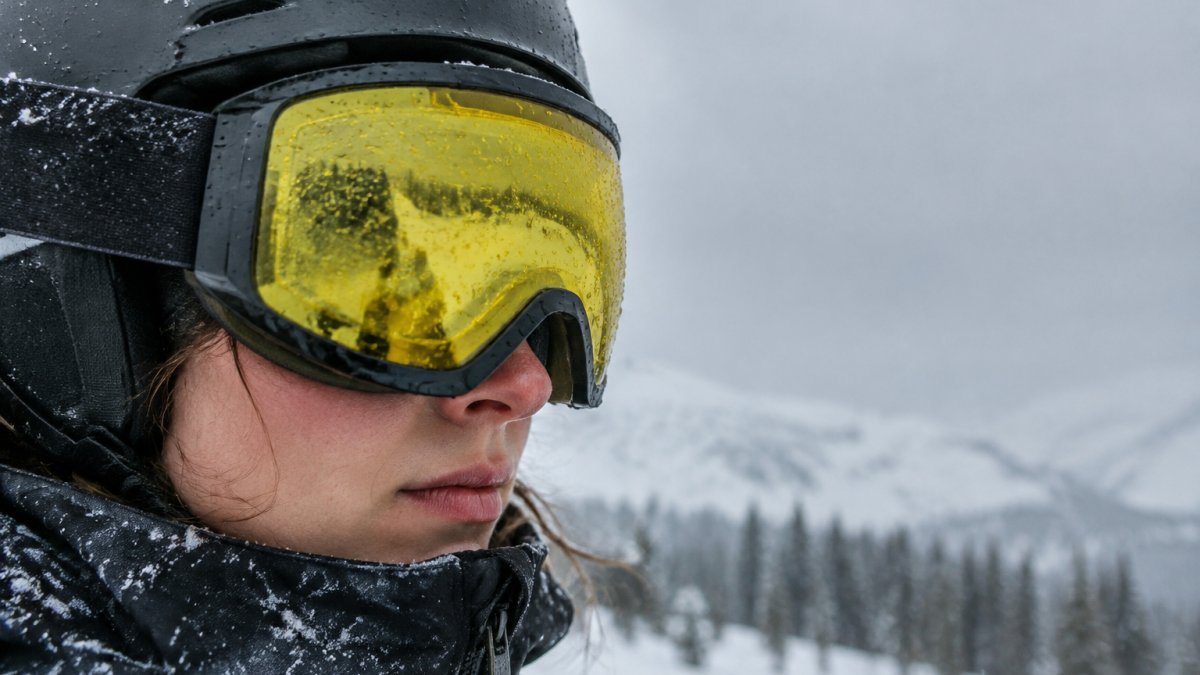
Colored lenses work by selectively filtering wavelengths. Yellow and rose tints absorb the blue end of the spectrum, which is the dominant scattered light under flat conditions. By reducing the blue haze, they increase the relative contrast between terrain features that reflect slightly different amounts of red and green light. The result is not that the world gets brighter, it is that edges become more defined. This is why a yellow lens can feel like it sharpens the snow even though it does not add light.
Rose and copper tints sit in a similar family but lean warmer. They tend to enhance the red-orange contrast that helps distinguish rock, ice and shadowed dips from the surrounding snow. On mixed days with brief sun breaks, rose lenses often feel more versatile than pure yellow because they retain some glare control while still lifting contrast.
Gray and mirrored lenses, by contrast, reduce overall light fairly evenly across the spectrum. They are excellent for bright sun because they cut glare without shifting color, but on a graybird day they mute the very luminance differences you need. A mirror coating can look aggressive in photos, but it also reflects light away from the eye, which is the opposite of what you want when the sky is flat.
A practical way to think about it: match the tint to the dominant light color. Blue-gray overcast favors yellow or rose. Warm, low-angle light favors copper or rose. Bright, neutral sun favors gray or mirrored. If you ride in mixed conditions, a rose base tint is often the best single compromise because it handles both flat light and brief sun without the extreme color shift of pure yellow.
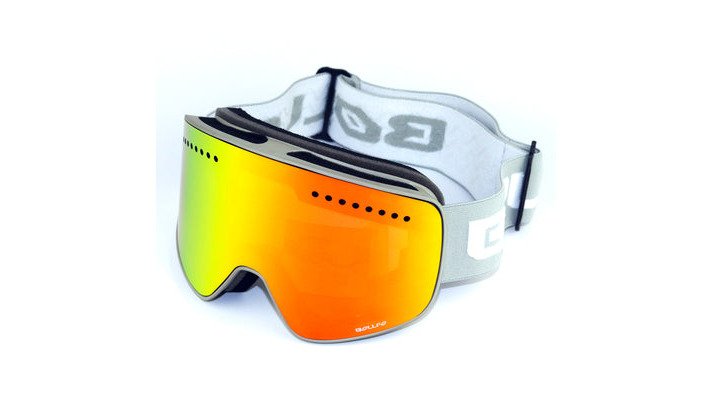
If you want to see a matching option, our magnetic ski goggles with yellow and clear lenses ship with both a yellow and a clear lens plus a case, so you can swap as the weather shifts.

Watch out: a lens that looks dark and mirrored in the shop may be the worst choice for the conditions you actually ride most. Judge the tint by the VLT and base color, not by the mirror finish.
Photochromic vs. Fixed Lenses: Which Handles Changing Light Better?
Photochromic lenses darken and lighten automatically as UV exposure changes. Fixed lenses stay at one tint. For flat light specifically, fixed wins on consistency, while photochromic wins on convenience.
The catch with photochromic glass is transition time. On a mountain where clouds roll in fast, a lens that's still adjusting leaves you a step behind. Fixed lenses give you a predictable, repeatable view every run.
Anti-Fog Goggle Care: Keeping Your Vision Clear in Wet Snow
Anti-fog goggle care is mostly about what you don't do. Never wipe the inside of the lens, because that's where the anti-fog coating lives. Wiping it smears the coating and fogging gets worse, not better.
Fog forms when warm, moist air from your face meets a cold lens. A dual-pane lens traps a layer of insulating air between two sheets, which is why double-layer designs resist fog far better than single panes. Ventilation and face foam density do the rest.
A practical routine:
Magnetic Ski Goggles with Yellow & Clear Lenses →
- Let goggles air-dry after each day; never leave them sealed in a bag
- Store them in a soft cloth bag, not against a wet jacket
- Keep the frame flush to your helmet to stop snow sneaking in
If fog is your main enemy, our customizable magnetic ski goggles with double-layer anti-fog are built around exactly that problem.
Magnetic Lens Systems and Field of View: What Matters on the Mountain
Magnetic lens systems let you swap tints in seconds without wrestling a frame. For flat light, that matters more than it sounds: conditions change fast, and a quick swap beats a fogged, wrong-tinted lens all afternoon.
Field of view is the other half of the story. Spherical lenses curve outward like a dome and tend to widen peripheral vision and reduce distortion at the edges. Cylindrical lenses are flatter and cheaper but can feel more tunnel-like. Peripheral vision is your early-warning system for other riders and hidden terrain.
If you're weighing a magnetic setup, our magnetic ski goggles with double-layer polarized lens show what that system looks like in practice.

Top Picks from ABsnowlife for Flat Light Conditions
A spherical, double-layer goggle is a practical option for flat light. Spherical shaping can widen your view, and a dual-pane build helps resist fog.
The spherical double-layer anti-fog ski goggles are a candidate here, with windproof, anti-fog and eye-protection functions and a TPU frame. Pair them with a low-VLT lens for bright days and a yellow or clear lens for the gray ones.

Best for: riders who want one goggle body and swap lenses by condition. Skip if: you only ski bluebird days and want a single dark lens.
Budget vs. Premium Lens Performance: What Your Money Actually Buys
Spending more on goggles buys you three things: better optical clarity, sturdier coatings, and lens-swap systems. It does not automatically buy better flat-light performance. Tint and VLT still do the heavy lifting, and the gap between a well-chosen mid-range lens and a premium one is narrower than marketing suggests, but it is real, and it shows up in specific ways.
The first place premium lenses earn their price is optical clarity. Cheaper lenses are often injection-molded, and while modern molding is good, premium brands typically use higher-grade materials and tighter quality control that reduce internal distortion and haze. In flat light, where you are already straining to detect subtle luminance differences, any haze or distortion inside the lens compounds the problem. A premium lens does not create contrast, but it avoids stealing it.
The second difference is coating durability. Anti-fog and anti-scratch coatings on budget lenses tend to be thinner and wear faster. A lens that fogs easily or has a scratched interior surface will degrade flat-light performance long before the tint becomes the limiting factor.
The third difference is consistency across the lens. Premium manufacturers often grade lenses for tint uniformity, so the color you see through the center matches the edges. Budget lenses can show slight color shifts toward the periphery, which is exactly where you rely on peripheral vision to catch terrain and other riders.
Where premium lenses do not automatically win is in the tint itself. A mid-range lens with the correct base color and VLT for flat light will outperform a premium lens in the wrong tint every time. The mistake many riders make is buying the most expensive goggle on the wall and assuming it will handle graybird days, when the lens they chose is a dark gray mirror built for bluebird conditions.
A practical framework for deciding: first, identify the VLT range and base tint that match your typical conditions. Second, decide how many lens swaps you are willing to do per day, if the answer is zero, invest in a photochromic or a versatile rose lens rather than a premium fixed lens. Third, spend up on build quality only after the tint is right. Coatings, frame fit and lens-swap systems are where extra money translates into real-world durability, not into better contrast on a gray day.
Prescription Inserts and Lens Maintenance for Longevity
Lens maintenance is where goggles live or die. Rinse with lukewarm water, pat dry with a soft cloth, and never use abrasive cleaners on the inside surface. Store them in a case, not loose in a pack where keys and edges do damage.
- Rinse after sweaty days to remove salt and sunscreen
- Air-dry fully before storing
- Replace scratched lenses before they ruin contrast
Find Your Flat Light Goggles at ABsnowlife
Flat light doesn't have to mean guessing where the snow ends and the sky begins. Get the VLT, tint and anti-fog design right, and the mountain comes back into focus.
At ABsnowlife, we curate winter gear for mountain and local snow activities. Our collection makes it easier to match a goggle to the weather you actually ride in, and our Pro Tec Low Pro snow helmet in matte grey rounds out a setup that fits together.
Get started with ABsnowlife and gear up for the gray days with confidence.
Frequently Asked Questions
What lens color is best for flat light skiing?
Yellow and rose base tints work best for flat light because they boost contrast without darkening the snow surface too much. Yellow lenses filter blue light, making terrain features like bumps and ridges stand out against gray skies. Rose tints enhance red and orange tones, which helps define snow texture. Avoid dark gray or mirrored lenses in flat light; they reduce visible light transmission and make whiteout conditions worse.
What VLT percentage is best for cloudy days?
For cloudy, flat light conditions, look for a VLT (visible light transmission) between 40% and 70%. This range lets enough light through to see terrain detail without causing glare. Lenses in the 10-20% VLT range are too dark for overcast days and should be saved for bright bluebird conditions. A yellow or rose lens in the 50-60% VLT range is a reliable choice for gray days.
Do polarized goggles help with flat light?
Polarized lenses reduce glare from reflective surfaces like snow and ice, which can help on bright days. In flat light, however, polarization can sometimes flatten contrast further by cutting too much reflected light. For pure flat light performance, a contrast-enhancing tint (yellow or rose) with a moderate VLT is more effective than polarization alone. Some skiers prefer non-polarized lenses for this reason.
How do I prevent my ski goggles from fogging in humid, snowy conditions?
Prevention starts with proper anti-fog goggle care: never wipe the inside of the lens, as this removes the anti-fog coating. Shake snow off your goggles before entering a warm lodge, and let them air-dry at room temperature. Use a double-layer lens, which creates a thermal barrier between warm moist air inside and cold air outside. Ensure your goggles fit well against your face without gaps that let moist air in.
Are photochromic lenses worth it for flat light?
Photochromic lenses adjust tint automatically as light changes, which is useful on days with variable conditions. For flat light, they can be worth it if you often ski from overcast into bright sun without wanting to swap lenses. However, they typically don't enhance contrast as strongly as a dedicated yellow or rose tint. If flat light is your primary concern, a fixed contrast-enhancing lens may outperform a photochromic one.
The next graybird morning is already on the forecast. Build a kit that sees through it, starting with a lens matched to the light and a frame built to swap fast. Browse the ABsnowlife collection and ride the flat light instead of fighting it.